Wednesday, April 25, 2012

Place Value of Decimals


Decimals: Place ValuePlace Value is really easy.

If you know place value after the decimal you can read fractions easily.

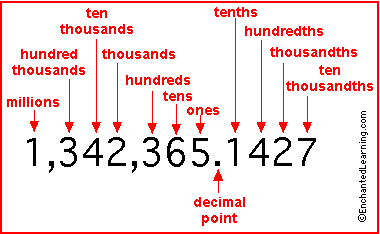
 As you can see in the picture you have the millions, hundred thousands, ten thousands, thousands, hundreds, tens, ones, then your decimal point, tenths, hundredths, thousandths, and ten thousandths.

For the whole numbers you read right to left.

 You could go as far as you like.

After a while, you will have memorized place value.

For extra practice you can make flashcards.

Or, you can play this game on IXL.


Place Value Practice Game 


Wednesday, April 11, 2012

Area of a Rectangle


To find the area of a rectangle you have to know the formula.

The formula l x w = a    l = length w = width a= area                                            
 
 You have to know this if you have a problem like this,' What is the area of a rectangle'.

                                                        7 in
                                                                                                                          
All you have to do is 3 x 7 = 21 squared  

So your answer is 21 inches squared.

On all rectangles, when you find the area you have to square it.

Wednesday, March 21, 2012

Metric Units

 Metric Units

mm= millimeter               10 mm= 1 cm

cm= centimeter               100 cm= 1 m

m= meter                        1000 m= 1 km

km= kilometer


13 mm + 24 cm in lowest terms.

Well, if you know there are 10 millimeters in 1 cm you can solve the problem.

13 + 24 = 37. Well, you can make 30.

You have 7 left over.

So, your answer is 30 cm and 7 millimeters.

Another Way to Remember


You can make flashcards to help you remember.  How did you start to learn these?


Metric Capacity 

milliliter (mL)               1,000 mL = 1 L

liter (L)                          250 mL = 1 metric cup

kiloliter (KL)                  4 metric cups = 1L

                                       1,000 L = 1 KL


Metric Mass 

milligram (mg)           1,000 mg = 1 g
 
gram (g)                      1,000 g = 1 kg

kilogram (kg)


Metric Comparing Practice

Customary Units

Customary Lengths


in= inch               12 in.= 1 ft

ft= foot                3 ft.= 1 yd

yd = yard              5,280 ft.= 1 mi

mi= mile               1,760 yd.= 1 mi


 You would use this information in a problem like this,

13 ft + 15 ft.

Well, 13 ft + 15 ft  = 28 ft


So, if you know 12 inches are in 1 foot you know that 24 inches is 2 feet.


Now, you have 4 inches left.


So your answer is 2 feet and 4 inches.

Another Way to Memorize 

You can make flashcards to help you memorize.
 
Before you do though how do you memorize?


Customary Capacity

Ounces (oz)               8 oz= 1 c

Cups (c)                      2 c= 1 pt

Pints (pt)                      2 pt= 1 qt                 

Quarts (pt)                   4 qt= 1 gal

Gallons (gal)


Customary Comparing Practice

Wednesday, March 14, 2012

Pi

Pi is a number you use to find the area and circumference of a circle.


Pi measures 3.14 in use of circumference and area of a circle.

  The formula for the area is circle graphic. r = radius.

  The diameter is all the way across.

  The radius is half the diameter.

  So, you have this problem, Find the area, so say they give you the diameter which is 4.

  So, half the diameter is the radius.

 So, the radius is 2.

 So, your problem is 3.14 x 2 2.

So, your answer in this case is 6.28 2.
The formula for the circumference is  circle graphic

So, say you have the problem, Find the circumference.


They give you the diameter which is 8.


So, you know your radius is 4. 


Your problem is 2 x 3.14 x 4.


So, your answer is 25.12


Pi Practice


Wednesday, March 7, 2012

Integers

Integers are all numbers meaning negative and positive numbers.

So, say you have the problem -5 - +7.

So, now your problem is -5 + -7.

So, -5 taken away from -7 is +2.

To go to game click on the link below.


Fun Integer Game


Wednesday, February 29, 2012

Triangles

There are lots of different types of triangles.

 There are three main triangles, Scalene, Isosceles, and an Equilateral.

 Every triangle measures 180 degrees.

 A Scalene Triangle has three different lengths are all different.

 For a Isosceles triangle 2 sides are the same and one is different.

 For an equilateral triangle all the sides are equal.


Classifying Triangles


Friday, February 24, 2012

How to Subtract Fractions with Unlike Denominators

So, say we have the problem 3/6 - 2/8.

Step One: First, you have to find the LCD which stands for Least Common Denominator.( If the smallest denominator divides evenly into the biggest denominator.

 So, think what is the least common multiple that 6 and 8 go into, it's 24. When you can't find the LCD you just multiply both the denominators together.

Step Two: So, you think 6 x ? = 24. It's 4 so you multiply the numerator by 4. So, your new fraction is 12/24.

You do the same thing to the other fraction. So, you think 8 x ? = 24, it's 3. So, you multiply the numerator by 3. So, your new fraction is 6/24.

Step Three: Then, all you have to do is subtract our fractions. So, our problem is 12/24 - 6/24 = 6/24.

Step Four: Finally, all you have to do is simplify. So, divide 6/24 by 6/6 = 1/4.

So, your final answer is 1/4.

To go to website click on the link below.

 Fraction Games

Thursday, February 23, 2012

Coordinate Grid

Do you want to know how yo use a Coordinate Grid? Well, check out this cool website I found! To go to the website click on the link below.


Coordinate Lessons

Tuesday, February 21, 2012

Why Do We Use Reciprocals

We use Reciprocals to divide fractions. Instead of dividing fractions we multiply them.

 So, say we have the problem 3/4 divided by 7/8, (but we don't know how to divide that yet.)

 So, we multiply the first number in this case it's 3. The second number we have to use the reciprocal of 7/8 so it would be 8/7. So, your problem is now 3/4 x 8/7 so 3 x 8 = 24.

So, that's your numerator 24 and your denominator 4 x 7 = 28.

 So, your fraction is 24/28 which now we have to simplify the number so your answer is 6/7 simplified.

 So you final answer is 6/7.

Reciprocals Practice Link

Reciprocal Lesson

Reciprocal Game

Monday, February 20, 2012

Divisibility Rules

Did you know there is a trick to divisibility? There are quite a lot. We know everything is divisible by 1 and everything that's an even number is  by 2.

3 is if the numbers in the number added up is divisible by 3. So, an example for three is like  4 goes into it. So, the number 1,234,328 is divisible by 4 because, 4 goes into 28 evenly.

5 is easy if the number ends in a 0 or 5 it's divisible by 5.
 Like this number 100,234,595 goes into 5 because, it ends in a 5.

 The one for 6 is if the number goes into 3 and 2. Like the number 342.

 A number that's divisible by 8 if the number formed by the last three digits is divisible by 8.

 The one for 9 is if the digits in the number all added up is divisible by 9.

 The one for 10 is if the number ends in a 0  it's  divisible by 10.

Divisibilty Practice

Friday, February 10, 2012

What are Factorials?

So, you see a problem that looks like this 5!

That is 5 factorial. All that means is you multiply 5 x 4 x 3 x 2 x 1 = 120

 If you see a fraction like this 6!/4!

Well you know how 6! means 6 x 5 x 4 x 3 x 2 x 1 and 4! means 4 x 3 x 2 x 1

All you have to do is cross out the numbers they have in common so, the problem is 6 x 5.

Therefore, your answer is 30.

Factorial Practice

How to Multiply Mixed Numbers

So, say you have the problem 2 and 3/8 x 5 and 3/5.

 First, you think what equals one whole with the denominator of 8.

 We know that it is 8/8 but, we have 2 so what is 8/8 + 8/8 + 3/8= 19/8.

Now, we do the same thing to 5 and 3/5. What equals 1 whole with the denominator of 5. So, our equation is 5/5 + 5/5 + 5/5 + 5/5 + 5/5 + 3/5= 28/5.

 Then, we just straight out multiply the numerators by each other and the denominators by each other. So, the equation now is 19/8 x 28/5= 532/40.

 Finally, we have to simplify so we have to think how many times does 40 go into 532. That is 13 and 12/532= 6/266= 3/133. So, you answer is 13 and 3/133.

Multiply Mixed Numbers

Thursday, February 9, 2012

Fun Math Games!!!

Fifth and Sixth Grade Math Games

What are Exponents?

So, you go to a problem that says 24 you probably think it means 2 x 4. Well, it actually means 2 x 2 x 2 x 2 = 16.

So, remember the large number is getting multiplied by itself how many times times the little number is.

So an example 5
9 means 5 x 5 x 5 x 5 x 5 x 5 x 5 x 5 x 5 = 1,953,125.  So, that's how you do exponents.

Exponent Practice

Wednesday, February 8, 2012

Adding Fractions with Unlike Denominators

So, say we have a problem like 2/5 + 1/3.

 You have to find the LCD which stands for least common denominator. The LCD is the smallest multiple of both those numbers go into.

 So, 5 and 3 both go into 30 but, that's not the LCD. The LCD would be 15 because, that's the smallest multiple they both go into.

 So, the denominators for both fractions are going to be 15.

 Then, you think 5 x ? = 15. In this case it's three. So, you multiply the two in 2/5 so 2 x 3= 6 and 5 x 3= 15 so the new fraction will be 6/15.

After that you do the same thing to 1/3. You think 3 x ?= 15. It's 5. So, you multiply the 1 in 1/3 so 1 x 5= 5 and 3 x 5= 15.

 So, your new fraction is 5/15. So now you add 6/15 + 5/15= 11/15.

 Finally, you check to see if it's in simplest form which it is because, 11 is a prime number. So, your final answer is 11/15.

Fraction Games 

For all Fractions